Has ICE had any additional impacts on northern PA communities since Trump’s second term?
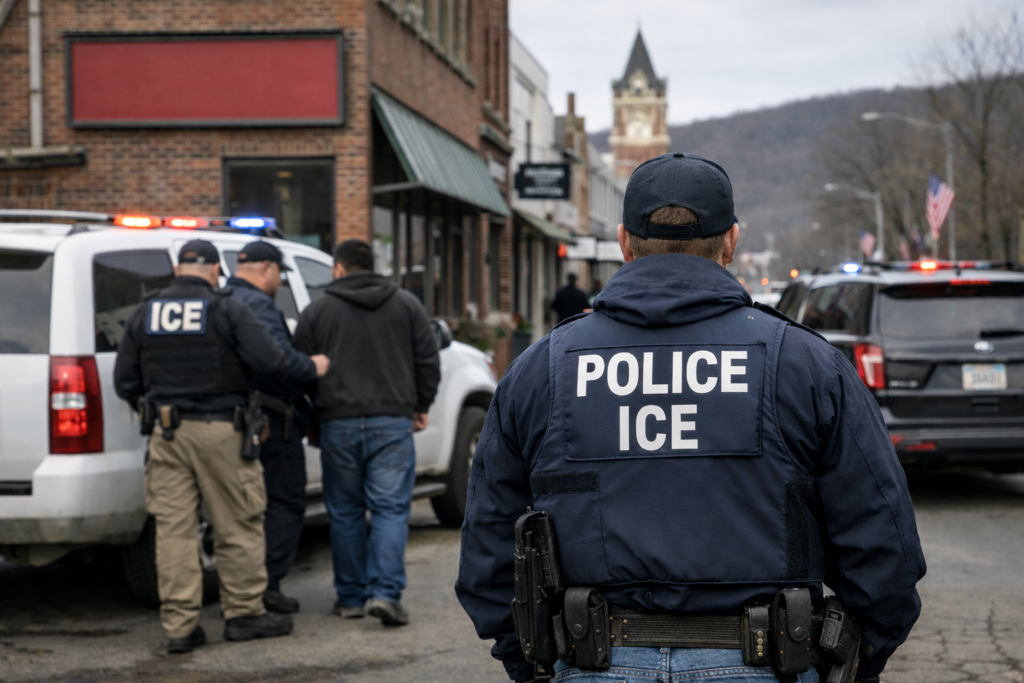
On a Monday morning in March, residents in Bradford — a small city tucked into the northern tier near the New York line — reported seeing U.S. Immigration and Customs Enforcement officers outside Taco Inc. on Main Street. The local paper’s item was short: agents were seen; no public accounting followed about arrests, warrants, or why federal officers were there. But in rural places where “big-city politics” often feels far away, the sight of federal badges at a neighborhood business can travel faster than any official statement. bradfordera.com
That moment, and others like it since President Donald Trump returned to office in January 2025, points to the main way ICE has been felt in northern Pennsylvania: not necessarily through frequent, headline-grabbing raids in Potter, McKean, or Tioga counties — public reporting on those counties remains thin — but through a combination of visible enforcement touchpoints, expanded cooperation infrastructure, and second-order effects that reshape daily routines in small towns: who shows up to work, who goes to court, which roads feel safe to drive, and how local officials talk about public safety.
This investigation draws on local reporting, statewide coverage, ICE statements summarized by regional outlets, and primary documents circulated inside Pennsylvania’s justice system. What emerges is a picture of added federal activity and influence since the second Trump term began, with impacts that are uneven, sometimes indirect, and increasingly tied to coordination with local agencies rather than standalone ICE operations.
1) McKean County: a brief sighting, a long ripple
The clearest, county-specific “ground truth” in the northern tier since January 2025 is the Bradford sighting.
The Bradford Era reported March 10, 2025 that ICE officers “were seen outside Taco Inc.” on Main Street. The report did not describe arrests or name targets, and there is no public follow-up in that item about the outcome. bradfordera.com
In an investigative sense, that absence of details matters. In large metro areas, ICE activity is often quickly triangulated by advocates, attorneys, and multiple newsrooms. In rural counties, a single sighting can become a stand-in for much bigger narratives — and that’s where the impact grows.
A statewide political outlet later described how, across Pennsylvania, rumors about ICE presence — even when wrong — have emptied restaurants and altered behavior since late January, after the administration directed more aggressive action. One restaurant owner described business collapsing amid gossip that ICE was at the restaurant, saying that even routine police activity now gets interpreted as immigration enforcement. City & State Pennsylvania
That kind of “ambient enforcement” effect is especially powerful in small communities. In places like Bradford, Coudersport, and Wellsboro — where service-sector businesses rely on repeat customers and where word-of-mouth is its own communications network — a single report can create days or weeks of economic and social aftershocks. Importantly, those impacts can occur even when enforcement activity itself is limited.
2) Potter and Tioga Counties: fewer confirmed operations, but growing proximity
Potter County: limited public reporting doesn’t mean “no impact”
In Potter County, public reporting since January 2025 does not show a clear, widely documented ICE enforcement action analogous to Bradford’s Taco Inc. sighting. That does not prove nothing happened — it means the public record is sparse.
What is visible is that Potter County’s district attorney is among those copied on Pennsylvania Commission for Fairness & Justice (PCFJ) correspondence addressing ICE presence “in and around courthouses.” In a March 2025 letter to Pennsylvania’s District Attorney Association, the Commission warned that ICE detentions near courthouses can deter victims and witnesses from participating in the legal system and urged prosecutors to take steps to reduce harm. The letter’s cc list includes Potter County’s DA. pa-interbranchcommission.com
For Potter County, where the courthouse is a central civic hub and where court-related travel can involve long drives from remote townships, even a small perceived risk of enforcement near judicial spaces can change behavior — the Commission’s central concern.
Tioga County: cooperation infrastructure comes closer
The biggest “additional impact” signal for Tioga County is not a headline raid, but the broader trend toward formal law enforcement partnerships with ICE under the federal 287(g) program — a set of agreements that deputize local officers for certain immigration-enforcement functions under ICE supervision.
Nationally, ICE’s own 287(g) program materials indicate a dramatic growth in agreements during 2025, with a large number of pending MOAs reported as of mid-2025. U.S. Immigration and Customs Enforcement The Markup, tracking the program, reported that 287(g) agreements more than doubled in the early months of the second Trump presidency. U.S. Immigration and Customs Enforcement
In Pennsylvania, a July 2025 public radio report described a wave of agencies joining or pursuing 287(g), quoting supporters who see the program as a way to align local policing with federal law while emphasizing that participation is framed as focused on people accused or convicted of crimes. 90.5 WESA
For northern counties, the key point is proximity: even if Tioga itself does not generate frequent ICE headlines, the operational “mesh” around it can tighten — through adjacent-county partners, state-level participation debates, and corridor-based enforcement that touches people traveling to work sites.
3) Northern PA’s new flashpoint: traffic stops and work-site routes
If Bradford illustrates the “sighting → ripple” pattern, Centre County illustrates the “corridor operation → regionwide warning” dynamic.
In August 2025, StateCollege.com reported that ICE confirmed arresting 24 people in a “targeted enforcement operation,” with arrests carried out during traffic stops on Interstate 99 and Route 220 near Bellefonte, following an investigation into people “suspected of temporarily residing” at a location. ICE publicly identified two individuals and described one as a suspected MS-13 gang member and another as having prior convictions including assault and resisting arrest. StateCollege.com+1
Separate local reporting and immigrant-rights networks described the same period as involving detentions of construction workers headed to a job site — showing how enforcement actions can quickly be experienced not as abstract policy, but as a direct disruption to labor and commuting patterns. StateCollege.com+1
Why does this matter for Potter, McKean, and Tioga?
Because northern Pennsylvania is stitched together by commuter routes and job-site travel far more than by big public transit systems. When a major enforcement operation plays out through traffic stops — rather than, say, a single workplace raid — it signals that enforcement can reach people in motion, including those traveling between counties for construction, healthcare, warehousing, or seasonal work.
From ICE’s perspective and from many local public-safety advocates, that approach is framed as targeted: identify suspects first, then execute stops as a controlled operation. From the standpoint of many immigrant families, it can feel like the opposite: if enforcement can happen on common highways, daily life becomes a risk calculation.
Both reactions are part of the “additional impact.”
4) The courthouse question: how justice-system leaders are preparing
One of the most concrete paper trails since the second Trump term began comes not from ICE, but from Pennsylvania’s justice-system institutions reacting to ICE’s presence.
In March 2025, PCFJ wrote Pennsylvania court leadership warning of “renewed concerns” about ICE presence not only in courthouses but also in probation offices and other judicial facilities, and said that since the new administration took office it had received reports of arrests or attempted arrests around courthouses and probation offices in multiple counties, including Philadelphia and several others. pa-interbranchcommission.com
A related March 2025 letter to the Pennsylvania District Attorney Association raised similar concerns, arguing that enforcement actions near courthouses create barriers to justice and could discourage crime reporting and participation by victims and witnesses. pa-interbranchcommission.com
For northern counties, the significance is twofold:
- Policy can travel faster than enforcement. Even if courthouse arrests are reported more often in larger counties, statewide guidance and anxiety can quickly influence how local attorneys advise clients and whether community members show up for hearings.
- Rural court users have fewer alternatives. In a city, a victim may find a community organization, a public defender office with immigration expertise, or alternative support networks. In small counties, fewer specialized resources means fear can have a larger dampening effect.
In other words: even when ICE action is elsewhere, the courthouse debate can land in Potter, McKean, and Tioga as a “shadow policy” — changing behavior without a single local raid.
5) The detention economy: Clearfield County’s Moshannon effect reaches north
Another “additional impact” since January 2025 is the growing prominence of Pennsylvania’s immigrant detention system as both a policy battleground and a local economic factor.
Spotlight PA reported in October 2025 that Clearfield County would make $1 million over five years by acting as a middleman in contracts between ICE and the private contractor operating the Moshannon Valley Processing Center, described as the largest immigration detention facility in the Northeast. Spotlight PA
Earlier Spotlight PA reporting described Moshannon’s population climbing, citing an average daily population figure of 1,309 in mid-2025 and noting the facility’s 1,876-bed capacity. Spotlight PA
Why does that matter to northern-tier communities?
Because detention facilities shape the geography of enforcement. People arrested in northern counties (or in corridor operations that affect northern commuters) can be transported into that system; attorneys and families may travel long distances; and local political debates about the facility can influence how nearby counties see ICE’s role — either as a federal necessity for carrying out immigration law or as a driver of local controversy.
Even for residents who never interact with the system directly, the facility’s presence anchors a broader sense that immigration enforcement is not “somewhere else.” It’s in Pennsylvania — and, increasingly, it has local financial and governance ties. Spotlight PA+1
6) Cooperation and politics: “public safety tool” vs “community chill”
The question at the heart of northern Pennsylvania is not only what ICE did, but how local institutions choose to relate to ICE.
Statewide reporting has captured a familiar split: supporters emphasize public safety and targeted enforcement; critics emphasize fear, civil liberties, and the risk of discouraging crime reporting.
In a May 2025 account of Pennsylvania’s changing climate, Bucks County Sheriff Fred Harran described his approach as not “going on raids,” but focusing on people with crimes and active warrants while pursuing certification to access ICE databases. City & State Pennsylvania
That framing resonates in many rural communities where law enforcement staffing is limited and where residents may be more receptive to the argument that cooperation makes enforcement more efficient and focused.
At the same time, the same statewide reporting described a broader environment where “everything is ICE” — a phrase capturing how routine police presence can be interpreted as immigration enforcement, with downstream impacts on restaurants, schools, and churches. City & State Pennsylvania
What’s new since January 2025 is less the existence of these arguments than their frequency and institutionalization — via more 287(g) activity, more public protests and counterspeech, more formal letters circulating among prosecutors and judges, and more operations executed through roads and traffic stops rather than only through workplace actions.
7) So — has ICE had “additional impacts” in northern PA?
Yes — but with an important qualifier: the additional impact is often indirect.
Based on public reporting and primary documents since January 2025:
- McKean County has at least one publicly documented instance of visible ICE presence at a local business, which can produce outsize community effects even without detailed official follow-up. bradfordera.com
- Potter and Tioga Counties show fewer publicly documented enforcement episodes, but the counties are pulled into statewide institutional responses — especially the courthouse/probation concerns raised by PCFJ — and are increasingly near an expanding network of cooperation and corridor-based enforcement. pa-interbranchcommission.com+1
- North-central Pennsylvania has experienced a high-visibility corridor operation (Centre County) that demonstrates how enforcement can be executed through traffic stops tied to an investigation, with ICE emphasizing public-safety-related allegations for at least two arrestees. StateCollege.com+1
- Detention infrastructure in central/northern PA has become more prominent, including local-government contracting dynamics that tie county finances to ICE detention operations. Spotlight PA+1
From a strictly enforcement-focused viewpoint, that constellation of changes can be read as “more federal presence and more coordination.” From a community-impact viewpoint, it can be read as “more uncertainty and more behavioral change,” even in places where ICE is rarely seen.
Both are true at the same time.